Thursday, October 14, 2010

US Dept of Ed budget equal to more than $2100 per kid under 18

According to The US Dept of Ed's Budget Office website  they have a budget of roughly $160 billion ($63.7 billion plus $96.8 billion). According to the US Census Bureau there are about 75 million kids under 18 in the US. That means that the US Dept of Ed budget is equal to more than $2100 per kid under 18.

As the US Dept of Ed says themselves on their site "...it is important to point out that education in America is primarily a State and local responsibility." So instead of them taxing all that money away from people, and spending money on figuring out how to redistribute it from far off in Washington, and making local schools jump through hoops to get that money, why not either not tax people for it, or give it back as vouchers so people can afford to send their kids to good schools? Instead of sacrificing children in hopes of eventually fixing schools allow parents to right away find a school that meets their kids needs.

Taxing people on a Federal and State (and possibly local) level for schools and then only providing money to public schools makes for a system that favors the wealthy, who can afford to send their children to private schools or move if need be. Poorer people are forced to keep their kids in worse schools while their money is put toward improving schools in ways their kids probably won't be around to benefit from.

The current public school system benefits beareaucrats and union members at the expense of students and poor parents. It assumes people potentially thousands of miles away know what your kids need better than you. And with their redistribution of your tax money, they exert influence, too. They take your money and then graciously give it back with conditions.

Friday, October 08, 2010

The auto industry is so predictable and boring and linear it almost seems like a cartel at times.

The auto industry is so predictable and boring and linear it almost seems like a cartel at times.


I wish cars were just made more reliable, rather than have new fancy features. I don't need wifi, satellite radio, automatically adjusting temperature controlled seats. I don't even want power windows. Give me the crank thing for windows so it doesn't break. Give me space for an actual tire, not a donut.

Don't come out with boring looking cars that look different from the boring looking cars of previous years. Might as well go full steam ahead for the sake of cheapness and don't change the design at all for 25 years at a time, and paint them all the same color. Would sure makes parts cheap. Or don't even have a body. Some models of Lotus and other cars are stock engines &/or frames from a manufacturer like Toyota and custom bodies. That way the cost of the functional parts would be lower and people could customize however they'd like. More of a motorcycle feel to it, I think. I don't mean the Scion model where you can choose rims and bumpers. Not even close.


Having standardized parts might mean that you could easily get books that would document how to fix things. I'm not mechanically inclined, so maybe this is just me, but I find those Chilton books very confusing, particularly when they show you a photo and it may have a ton of differences from what you have based on different years and models.  Here's a crazy thought, you could even put labels on parts in the car, so if I look under the hood I'd see what's the head gasket and what the serpentine belt and what not are.

I know it seems hugely controversial for some reason to have a car that can get all it's power from an outlet. But how about if I could just plug my car in so that my regular battery could be fully charged every morning.

And if a car were standardized, I think mods to it that didn't just apply to the exterior or aesthetic elements would be easier to do and more importantly, to repeat. This might allow people to switch out how their car gets its power, for instance. Why is it anyone's business how you power your car? I don't think we need some national referendum if you want to make your car powered by charcoal and you can car-b-que while you drive. And if there was some consistency in cars, better documentation, tons of cheap parts, this would be possible. Encourage dealerships to do it, if you want to try to keep it in the family.

There are a million computers in cars now? How about a USB cord so I could plug it into a laptop, run some diagnostic program, and I could be told what's not working properly?

Wednesday, September 29, 2010

An Alternative to our current US tax system?

I don't think I'm alone in thinking the US tax system seems overly complicated. It doesn't look like it really works. It discourages savings, makes running a business too complicated for some to consider, seems to favor those who can trick the system, and it requires an army of people in the IRS as well as a comparably large army of accountants.

"The President requested $12.6 billion to fund IRS's fiscal year (FY) 2011 operations, including $5.8 billion for enforcement, $4.1 billion for operations support, and $2.3 billion for taxpayer services." - U.S. Government Accountability Office

There have been a lot of ideas for simplifying the tax system. Criticisms are typically that they wouldn't generate enough revenue, they'd tax the poor unreasonably, or they too would be overly complicated.

The X Tax: The Progressive Consumption Tax America Needs? looks like a well thought out, interesting alternative that keeps these criticisms in mind. I'd be interested in hearing what others think of it.


"Good tax policy should be pro-growth, simple, and fair. An income tax, unlike a consumption tax, penalizes saving, which undermines economic growth and introduces complexity. An income tax is often thought to be fairer than a consumption tax, however, because it taxes saving, which is disproportionately done by higher-income individuals. In reality, however, a consumption tax can be designed to be as progressive as the current income tax. The Bradford X tax offers an attractive, if little-known, form of progressive consumption taxation."
- December 2008
 

Tuesday, September 28, 2010

Innovation, Full Employment, Workers Rights and all that good stuff

In arguments between the dominant two political parties in the US we often hear debates on employment, benefits, workers rights and such subjects pitted as big business versus workers. How can business thrive, so that people can have jobs and people can have investments for their retirement that have a positive return, while at the same time people can have work that pays, has benefits and isn't oppressive?


Flea Market Browsers at White Cloud, Kansas, near Troy, in the Northeast Corner of the State. It Is Sponsored by the Ma Hush Ka (Iowa Indian Language Meaning White Cloud) Historical Society to Raise Money for the Local Museum Housed in the 100-Year-Old Schoolhouse. Area Indians Participate in the Flea Market in Which Native Crafts as Well as Antiques Are Featured. The Town Is Named after the Last Great Iowa Indian Chief Whose Tribe Was Given Area Land by Treaty 09/1974


At the same time we hear how small business is the backbone of the country, the biggest employer, etc. So why is small business pretty much ignored? Laws and financial help from the government center on either big business or workers. Companies are bailed out when they're too big to fail. The assumption is that this is the only way to save our economy and people's jobs. In reality it's insanely lazy and really only helps big companies, big investors, and big unions.

Money is handed out to banks with the assumption it will magically trickle down to small businesses. But those small businesses are risky. They're owned by people who have often wrecked their credit to make those businesses work, or who started a business when they were broke from lack of work. Banks don't like risk. Handing a mega bank a truckload of money and thinking it's going to somehow make it to local dry cleaners and pool cleaning companies is beyond naive.  If you operate a small business you're pretty much on your own.

What could the government do to benefit small businesses? Probably the best thing to do would be to stop what they are doing. Get out of the way. Stop propping up big businesses. Stop charging the American people to hand money out to big banks thinking it will benefit anyone other than banks, big business and share holders of big business. Stop thinking unions are the representatives of all people who work.

Once they stop what they're doing, maybe they can help small businesses. Why would you want to do that? Small businesses are nimble, they innovate, they employ locally. What could be done to help?

Health insurance - break down barriers to allowing small companies to get affordable insurance. If a national scheme works, fine. Otherwise, just allow insurance companies to operate across state lines, allow groups to organize themselves, etc.

Access to capital - a slow down of a couple of months or a need to invest in equipment can be a death sentence for small businesses. Make money flow easier. Work more with SCORE to help small businesses get guaranteed loans. Establish micro lending operations like have been done to help businesses grow in the third world.

Mindset - it may seem to run contrary to common logic, but the reality is many businesses in America are too big to succeed. They are slow to change and innovate. They don't have a good handle on the profit and quality of the individual components of their products. They struggle endlessly with their relationship with employees.

With a small company a larger percentage of employees are owners. They'll work as hard as they need to and as hard as they are willing to succeed. If you're an owner you don't worry about your treatment by management - your treatment is a result of your success or failure.

When people don't have opportunity, they make their own opportunities. They start businesses. I started my business when I didn't have work. Undocumented workers start lawn mowing, childcare, house cleaning and piece work manufacturing operations that they can do from home when they can't find work.

What if instead of trying to stop these things from happening by artificially supporting huge companies, treating unions as the representatives of all the employed, worshiping employment statistics, and legislating against businesses we instead helped people work and own their companies.

Monday, September 27, 2010

Some things that make a war in Iran not seem that silly

I'm not advocating war with Iran. I don't particularly love Iran - I think Mahmoud Ahmadinejad is a nut. I think the people of Iran seem quite repressed and they don't seem to have any rights. Iran poses a constant threat to Israel, they execute more people than any country other than China, despite being the 17th most populous country, and evidence points to them supplying insurgents in Iraq.

Often times when you hear the possibility of war with Iran raised you'll hear pundits and commentators criticize the thought of getting into a third war. That might be true, but in some ways it's like saying you're eating two slices of bread and you might have some peanut butter when you're having a peanut butter and jelly sandwich.

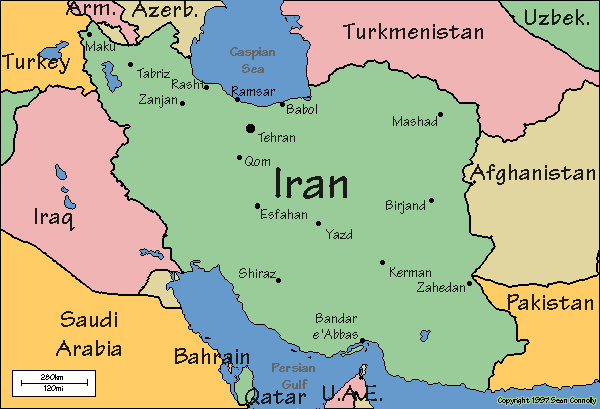
The reason I say this is, as you'll see from this cute map I found, Iran is right in the middle of Iraq and Afghanistan. In fact, Iraq and Afghanistan are less than 900 miles apart, all through Iran. So if you wanted to move troups and supplies between Iraq and Afghanistan, instead of having to go through Pakistan, across the ocean and land, you could go across Iran. In case you're thinking Iran might be a rugged frontier like Afghanistan I'd like to inform you that according to what I learned in college from writing a paper on the train system of Iran in a Persian history class, their infrastructure is quite good, at least in places.

Aside from supply line logistics, there's the issue of where terrorists and insurgents are getting supplied from. Any talk of fighters in Afghanistan, Iraq or Israel will at some point make mention of Iran.

Just to clarify, I'm not advocating war with Iran, or saying I'm in favor of it. I just want to point out that it's less like deciding to fight another country in a far off land and more like consolidating lines and removing sources of unrest in the areas we're already in. Of course, the fact that they are an Islamacists government and their country has oil and they can't seem to stop trying to make nukes doesn't help their case.

Tuesday, September 21, 2010

Bush tax cuts

I'm no economist, so my thoughts on the Bush tax cuts expiring are not initially whether this would spur economic growth or remove a revenue stream. What I notice more is the problem with the debate about them.

Our Congressman are arguing vigorously about whether the tax cuts for those earning over $250k a year should be renewed or allowed to expire. If you're a Paygo person, believing that all payments or tax cuts should be paid for as you go, then you need to know where the money will come from to pay for this tax cut. Who is supplying the money those earning over $250k a year aren't? That makes sense.

What doesn't make sense is how Congressmen on one side of the aisle argue that this is a tax cut for the wealthy, while those on the other side argue that allowing the tax cut to expire would harm small businesses. They appear to be arguing with each other, but are saying completely different things. In addition to not being an economist, I'm not a trained mediator. However, in my experience, if there's an argument the first thing that has to be done is to clarify what's being argued about.

It would be really great if everyone sat down calmly and answered the following questions:
  • Does this tax cut benefit those earning over $250k year?
  • Are those who earn over $250k always wealthy enough that taxing them like this is not unnecessarily burdensome? Always? Some of the time?
  • Would this have a negative impact on small businesses? Just a small percentage of them, or most?
  • If it would harm small businesses what could be done so they wouldn't be harmed?

Tuesday, March 30, 2010

Hulu tip: walk away from ads and miss nothing

Hulu tip: click on an ad when it comes up, close the new window, press play in the Hulu window. When the ad ends you have to hit play to get the video to play again. So when the ad comes up do what I described and go get a drink or mute it and watch something else until you want to go back.

Tuesday, February 23, 2010

Now that's a large

Thar she blows!
It's no secret that fast food drinks keep getting bigger. I'm fairly sure after a recent visit to a Schlotsky's that they've removed 'small' as a drink option. Aside from the fact that none of their drinks might in fact be small, it's psychologically jarring for me to start out at medium. Medium implies it's the middle.

I digress. This really isn't about size craziness. We're all past that now. You order a Starbucks now you order a Tall or a Venti or whatever. If we're using what I imagine are made up names for sizes why should anyone care if words that up to this point have actually described drink sizes are re purposed.

This is really about whether there isn't a Moore's Law for beverage containers. For those who don't know, Moore's Law, according to Wikipedia, "...describes a long-term trend in the history of computing hardware, in which the number of transistors that can be placed inexpensively on an integrated circuit has doubled approximately every two years." I'll trust my engineering/physics friends to spell this out in formulas, but essentially, I'm wondering about the increasing requirements of beverage containers. As the volume of liquid increases (I got a large today at Jack in the Box and that thing must be 44oz) the outward pressure on the cup must be increasing . Can styrofoam handle it? Are we on the verge of an innovation in inexpensive, disposable cup materials, or will we be stuck at this point in our thirst quenching development history? Can we pull together to push modern science to the point where we hit the 86oz mark?

Monday, January 04, 2010

Managing files & email

In an effort to limit the number of emails and files I have to contend with at any given point I've started my Daily plan. In this plan I have a folder within Documents called Daily where I put files I'll only need temporarily (say a PDF version of a file I need to email to someone). At the end of every day I can select all and delete, or if I feel really confident in my system I can set up a job to clear it out daily.

Similarly, with email I've set up a filter that various status and promotional emails that come in are labeled Daily, and I can easily select all and delete them if I wish.

Easy stuff to do and it helps in keeping the load of information floating around down. No one wants a desktop and Documents folder chock full of files you're not sure what to do with.